
The Real Kessler Effect and Our Chain Reaction Game
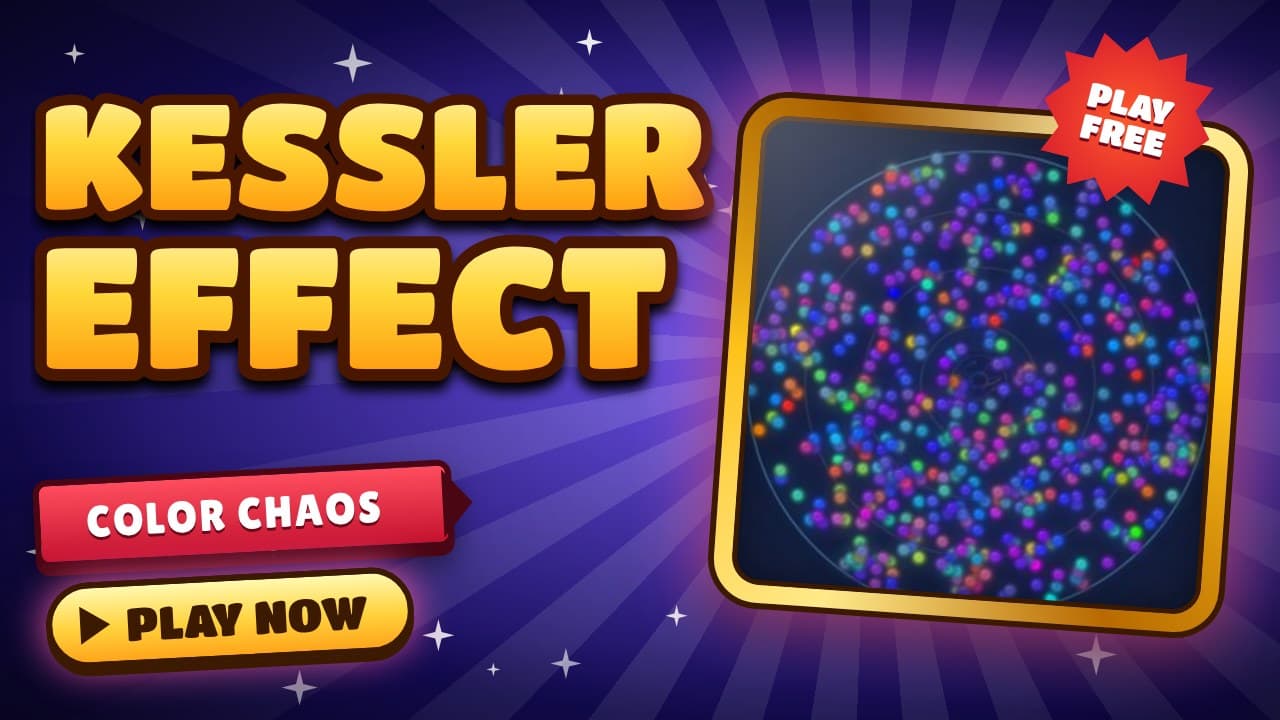
Our Chain Reaction simulation was inspired by a real idea in space science. In 1978, NASA scientist Donald Kessler described how collisions between objects in orbit could create debris, which in turn causes more collisions. Our game borrows the idea of a chain reaction, but swaps dangerous debris for something much friendlier: colour.
The real Kessler syndrome
Satellites and spent rocket parts travel at very high speeds. If two of them collide, they break into many smaller fragments, and each fragment can hit something else. In the worst case the process feeds itself, making some orbits harder to use. This idea is called the Kessler syndrome, and it is one reason space agencies pay attention to debris.
The key feature is not the destruction itself, but the cascade: a small number of events lead to a rapidly growing number of events.
How the game works
In Chain Reaction you choose between two and six starting balls and give each one a colour, from nine quick swatches or a custom picker. After a five-second countdown during which the balls pass through each other, collisions switch on.
Whenever two balls hit, they bounce apart and a new ball appears between them, coloured as a blend of its two parents. Every new ball can collide and create another, so the population snowballs until the circular arena holds a swarm of up to 600 balls.
Why it starts slowly
At first only a few balls exist, so collisions are rare. Each collision adds a ball, which adds more chances for collisions. That is exponential growth in action: slow at first, then suddenly fast. Real cascades behave the same way, which is why they can seem to come out of nowhere.
After the 600-ball cap no new balls appear, but the swarm keeps moving, so you can study the final colour mix.
Choosing colours that tell a story
Strongly contrasting starting colours, such as red, green and blue, make it easiest to watch blends spread. Blends are pushed back toward full saturation, so the colours stay vivid instead of fading to grey as the swarm grows.
Try starting with two similar colours and see how long they dominate, or start with six very different colours and watch which one ends up most common. The heading on the screen asks which colour will dominate, and the answer changes from run to run.
A calm kind of chaos
Collision sounds get louder as the action builds, and there is nothing to control once the simulation starts. It is a good game to leave on while you do something else. When you want a new result, reload the page and pick new colours.
Open Chain Reaction and pick your colours.