Why Drawing Physics Puzzles Feel So Satisfying
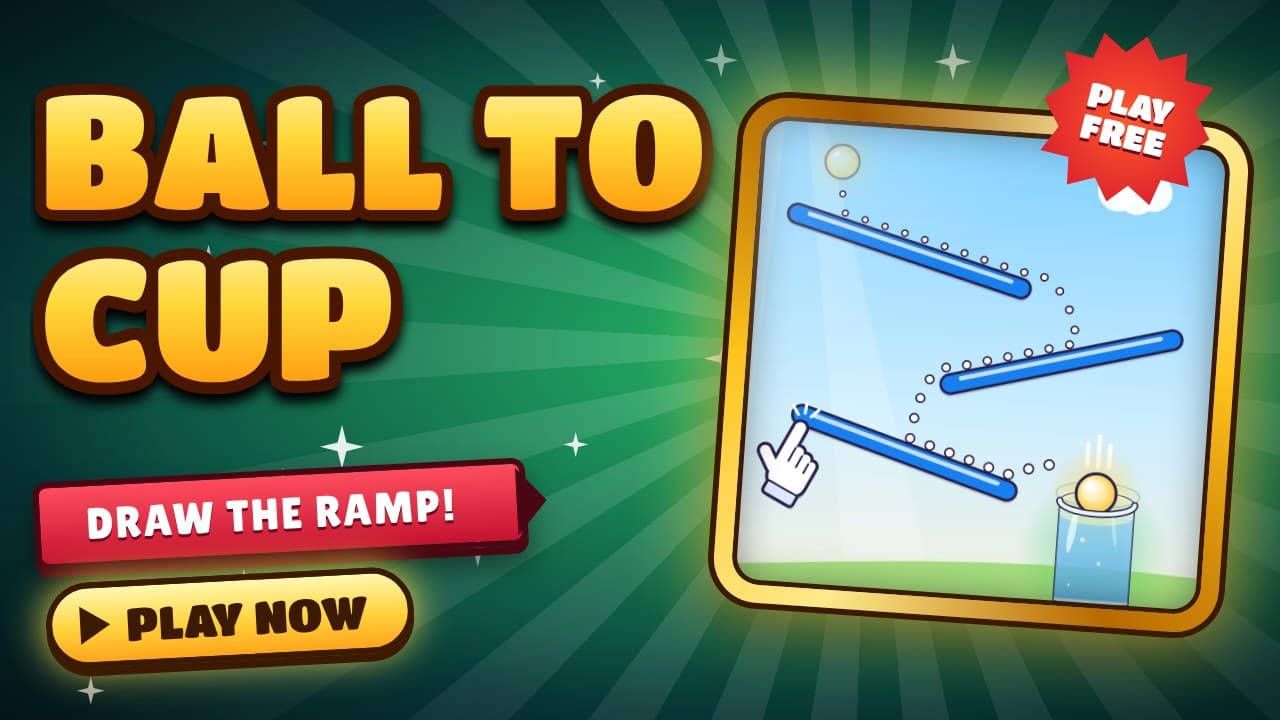
There is a family of mobile and browser puzzle games where you draw a line, release something, and then watch what happens. Ball to Cup is one of ours. These games are popular for a reason, and the reason has less to do with difficulty than with how they let you interact.
You make one decision, then you watch
In many puzzle games you make a long chain of moves. In a drawing puzzle you make a single decision (where and how to draw) and the game then plays it out. The wait between your action and the result is short, usually only a few seconds, and it is full of small suspense: will it make it, or will it miss by a hair?
That rhythm of act, watch, adjust is easy to repeat. It is also forgiving. A failed attempt costs you a few seconds and gives you information, so you try again without frustration.
Physics people already understand
Everyone has a feel for how a ball rolls down a slope or bounces off a surface. A good physics puzzle uses that intuition. You do not need a tutorial to know that a steeper ramp makes the ball faster, so you can start playing straight away.
The challenge comes from combining things you already understand: a slope, a bounce, a moving target. The solution feels earned because you reasoned it out, even if you got there by trying three or four variations.
Many answers, not one
A well designed drawing puzzle rarely has just one correct solution. Two players can solve the same level with completely different ramps. That freedom is a big part of the appeal: your solution feels like yours, not like the one the designer hid.
It also makes the games friendly to different play styles. Some players plan carefully, others draw quickly and adjust, and both approaches work.
Small levels fit small breaks
Levels in Ball to Cup are short, often solved in under a minute. That makes the game a good fit for a gap in your day: waiting for a bus, a break between tasks, or a few minutes before bed. Progress is saved in your browser, so you can stop at any time and pick up where you left off.
Short levels also create a gentle sense of momentum. One more level never feels like a big commitment, which is why people often end up playing for longer than they planned.
What we kept in mind when building Ball to Cup
When we put Ball to Cup together, we focused on a few things: clear goals (the ball goes in the cup), instant feedback (the ball moves the moment you let go), and gradual variety. New worlds change the look and the drink in the cup, while later levels add moving cups, fans and bouncy ramps so the game keeps surprising you without becoming confusing.
If you have not tried it yet, you can play it for free in your browser, with no download and no account.