
Circle Illusion: How Straight Lines Make a Rolling Circle
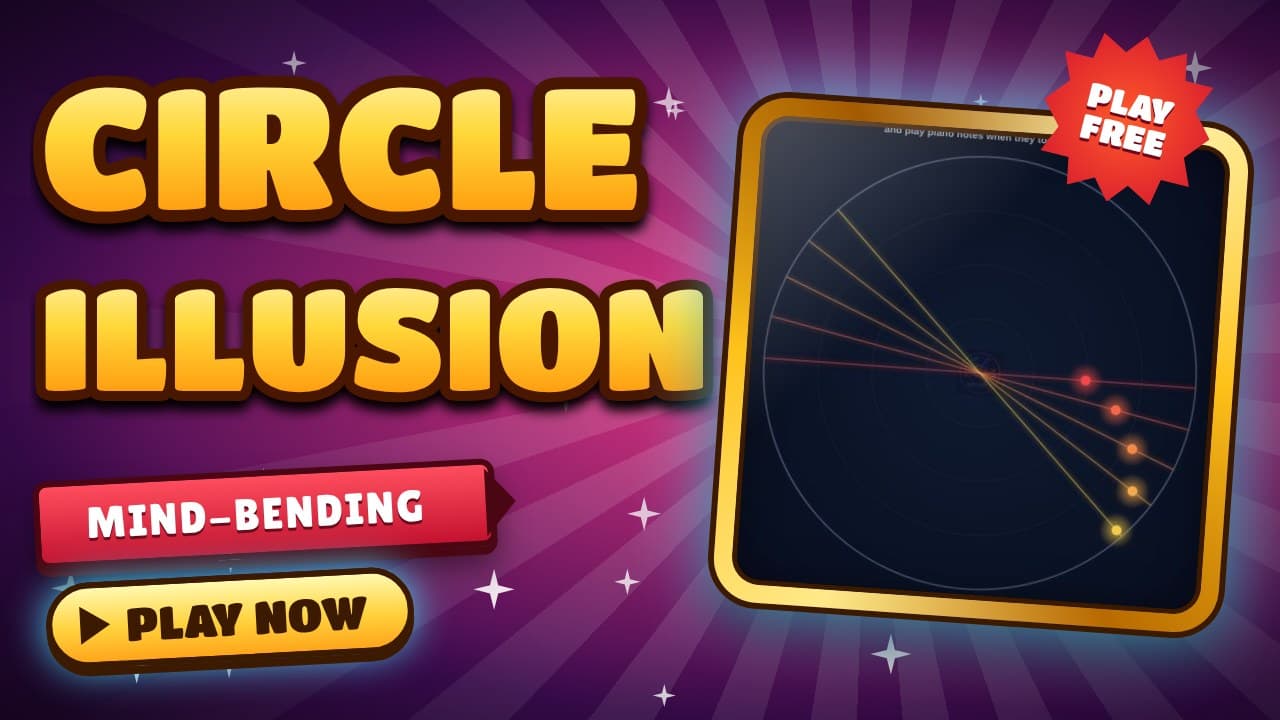
Watch Circle Illusion for a minute and it is hard to believe that every ball is moving in a straight line. Yet the whole group seems to trace a circle rolling around inside a ring. This post explains why, with no maths needed beyond a picture in your head.
What you see on screen
Inside a large ring, coloured lines are added through the centre, one every three seconds. On each line a single glowing ball moves straight back and forth. After about 45 seconds there are 16 lines, each with its own rainbow colour.
Each time a ball touches the outer ring, it plays a piano note, so the animation also builds a gently repeating melody. Tap or click once to enable sound.
Simple harmonic motion
A ball moving on its line is fastest in the middle and slowest at the ends, where it turns around. This smooth motion is called simple harmonic motion, and it is the same motion as a weight on a spring or a pendulum making small swings.
Mathematically, it is also what you get if you look at a point travelling around a circle from the side: its shadow slides back and forth in exactly this way.
Why timing creates the circle
Each ball is timed slightly later than the one before it. Because of this small delay, the balls are never all at the same place on their lines. When you look at all of them at once, your eye connects them into a shape.
That shape is a circle half the width of the outer ring, and it always touches the ring's edge as it rolls. This is a classic geometric fact: when a circle rolls inside another circle twice its size, a point on the smaller circle moves back and forth along a straight line. It is sometimes called a Tusi couple.
Try the finger test
Cover all but one ball with your finger. On its own, it is clearly just sliding along a line. Now uncover the others. The motion of the whole group looks completely different. Nothing has changed except what your eye is grouping together.
That is the illusion: your brain prefers to see one rolling circle rather than sixteen separate sliders.
Sound and layers
Each line has its own note, so the melody follows the order in which the balls reach the ring. After the first 16 lines, new lines run along the same diameters and their balls sit exactly on top of the earlier ones, so the shape stays the same while the colours and notes layer up.
It is a relaxing animation, with no goals or controls. Open Circle Illusion and watch the circle appear.